Contradicting Information?
Climate Change and Fisheries
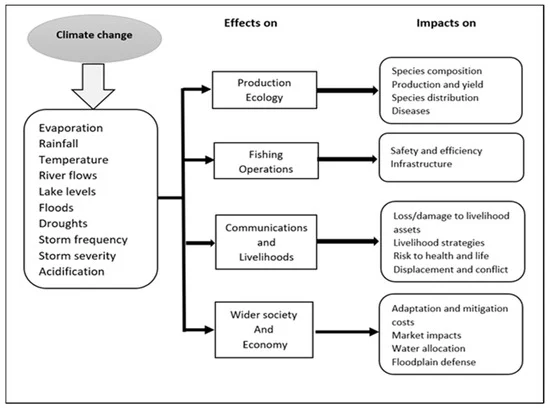
In a review of Sub-Saharan Africa freshwater fisheries, researchers found that climate change is a major threat to inland freshwater fisheries. Changing variables such as rainfall and temperature alter the processes of the fish and result in a decline of their productivity and fish catches. They reason that any action taken to combat this problem without consideration of the resource users is not advisable or as effective as it needs to be. The involvement of the resource users and fishers in making policy is of the utmost importance. Any solutions are location specific. The authors encourage future assessments to be done measuring how vulnerable the local area is. Overfishing and poor land use should be avoided or mitigated.
Complete Information
This piece provides a counter to the evidence found in the other sources which ultimately determine that illegal activities such as poaching and trafficking were a larger danger to wildlife than climate change. This article adds to the discussion by incorporating data regarding fish and the difference there is when looking at an animal that is perhaps less susceptible to illegal wildlife trade. It assists in gaining a more well-rounded look at the intersection between poaching and trafficking and climate change in all aspects.
FisheriesLimitations to Studies
There are limitations to the research that has been gathered. For example, the difference in levels of rainfall across Kruger. This changed the amount of grass available for the rhino populations. The authors of that study also identified that the hidden demographic risks associated with the poaching of female rhinos with calves may skew the data. They also noted that rhino gestation periods are long (15 or 16 months for black and white rhinos respectively) and so any changes in birth rate would be 1-2 years after a drought. Another set of authors concluded that returning seized animals to their indigenous homes is most important even if said area has been impacted by climate change, but they do not really address the pitfalls of that solution. They do not delve deep into how governments should specifically go about doing so. Other authors noted that it is likely that the amount of calf mortalities has been underreported due to their lesser influence on the landscape in comparison to adult rhinos. They made many assumptions making their models and they are predictions that may therefore be incorrect. Accurately modeling such a high level of variation requires far more data than they had access to. These gaps of data and research limitations may have impacted the results of their research, but each group of authors did what they could to lessen such factors and noted their existence in their published writing.
Destro, et al., 2019. Nhleko, et al., 2022 Ferreira, et al., 2019Incomplete Data
Wild animal populations are hard to have exact data for because of how large and vast they are and there is not enough manpower to tag every animal in the world. By conducting further studies and continuing to monitor how both poaching and climate change rates progress the authors hope to determine the best way to help protect wild animals.